
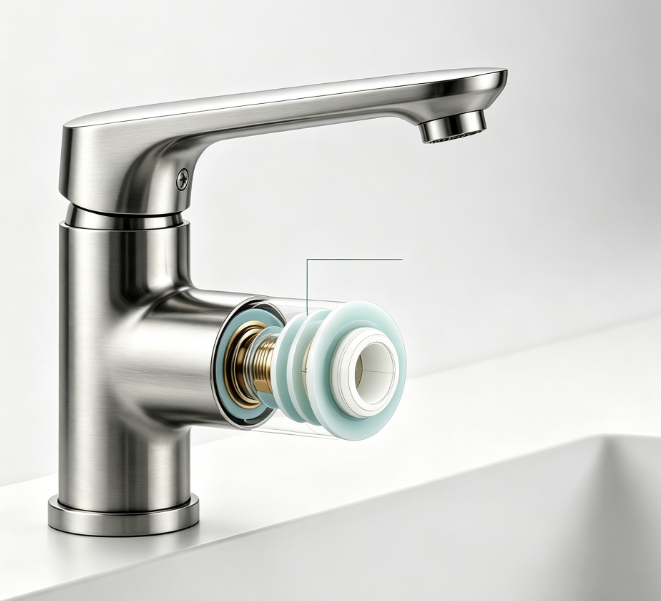
Ceramic Cartridge vs. Plastic Cartridge: Faucet Inner Valve Comparison
1. Introduction: The Component That Defines the Faucet
The cartridge is the heart of the faucet. It is the component that controls flow rate, temperature mixing, and shutoff. It determines how the handle feels when the user turns it, how long the faucet lasts before it drips, and whether the faucet can be repaired or must be replaced entirely.
Two cartridge technologies dominate the market: ceramic disc cartridges and plastic cartridges — the latter often using a plastic housing with rubber or plastic sealing elements. Both are used in single-handle mixing faucets across residential and commercial applications. But they perform very differently in durability, water quality tolerance, and cost structure.
A high-quality ceramic cartridge is precision-ground, moves smoothly, and can last over 500,000 cycles. A low-grade cartridge uses poor-quality materials, feels rough, and may start dripping or leaking within months. The cost difference for the cartridge alone can be several times higher.
This guide breaks down the two cartridge types — the construction, the durability data, the water quality sensitivity, the cost structure, and the selection framework that matches the cartridge to the application.
2. What Each Cartridge Actually Is
The two cartridge types look similar from the outside. They perform very differently on the inside.
Ceramic disc cartridges use two precision-ground ceramic discs — typically made from sintered aluminum oxide (Al₂O₃) — that slide against each other to control flow and temperature. One disc is fixed; the other rotates with the handle. The mating surfaces are polished to a flatness measured in microns. When the discs are aligned, water flows. When they are rotated to the closed position, the polished surfaces seal against each other with no rubber washer required.
The ceramic material offers very high resistance to wear, corrosion, and frictional drag, and it will not contaminate the water that contacts it.
Plastic cartridges use a plastic housing with internal sealing elements — typically rubber O-rings or plastic sealing discs. The cartridge body is made from engineering plastics such as POM (polyoxymethylene), PPA (polyphthalamide), or PBT (polybutylene terephthalate), often glass-fiber reinforced for dimensional stability. The sealing mechanism relies on the compression of rubber or plastic elements against a seat. Over time, these elements wear, deform, and lose their sealing capability.
Some plastic cartridges also incorporate a ceramic disc inside a plastic housing — a hybrid design that captures some of the ceramic durability at a lower cost than a full ceramic cartridge.
3. Material Construction and Working Principle
The working principle of each cartridge determines its failure mode.
Ceramic disc operation. The two ceramic discs are lapped to a mirror finish. The contact surfaces are flat enough that water cannot pass between them when they are in the closed position. The seal is achieved by surface flatness and contact pressure, not by a compressible gasket. There is no rubber to degrade, no O-ring to harden, and no spring to fatigue. The cartridge either works or it does not — and when it fails, it is usually because debris has chipped the ceramic surface or mineral deposits have interfered with the disc movement.
Plastic cartridge operation. The plastic cartridge relies on elastomeric sealing elements to control water flow. When the handle is turned, a plastic stem moves a sealing disc or compresses a rubber seal against a seat. The seal depends on the rubber maintaining its elasticity and the plastic maintaining its dimensional stability. Both degrade over time. The rubber hardens, cracks, or takes a permanent set. The plastic housing can creep under sustained load or crack under thermal cycling.
The practical difference is that a ceramic cartridge fails from external contamination — debris, scale, or a manufacturing defect. A plastic cartridge fails from internal material degradation — the normal aging of rubber and plastic under thermal and mechanical stress.
4. Durability: Cycle Life and Wear Resistance
The durability data is the primary differentiator between the two cartridge types.
Ceramic cartridge cycle life. The industry benchmark for a quality ceramic cartridge is 500,000 cycles. This is the standard that reputable manufacturers test to and advertise. Some premium cartridges exceed this threshold. Ceramic cartridges are generally expected to last 20+ years in normal residential use.
The wear resistance of ceramic is exceptional. The ceramic discs resist wear from friction and scale buildup far better than traditional rubber seal designs. The material does not corrode, does not absorb water, and does not degrade under thermal cycling. In hard water conditions, ceramic cartridges hold up better long-term with less corrosion and smoother operation overall.
Plastic cartridge cycle life. Plastic cartridges typically last 5–15 years depending on water quality and usage frequency. The cycle life is lower because the sealing elements degrade over time. The rubber O-rings or sealing discs harden, crack, or lose their compression set, and the plastic housing can deform under thermal stress.
In practical terms, a plastic cartridge may start to drip again after a few months to a few years, depending on the quality of the cartridge and the water conditions. A high-quality plastic cartridge in a well-maintained faucet can last longer, but it does not match the 500,000-cycle benchmark of a quality ceramic cartridge.
Durability Metric | Ceramic Cartridge | Plastic Cartridge |
Tested cycle life | 500,000 cycles | Not standardized; varies widely |
Expected service life | 20+ years | 5–15 years |
Wear mechanism | External: debris, scale | Internal: rubber aging, plastic creep |
Hard water tolerance | Excellent | Moderate |
Thermal cycling resistance | Excellent | Moderate |
5. Water Quality Sensitivity: Hard Water, Debris, and Mineral Buildup
Water quality is the variable that most affects cartridge performance in real-world conditions. And the two cartridge types respond differently.
Ceramic cartridges in hard water. Ceramic cartridges generally hold up better in hard water conditions. The polished ceramic surfaces resist scale adhesion because there are no pores or irregularities for the minerals to grip. The smooth operation is maintained even when the water contains dissolved minerals. The primary failure mode in hard water is scale buildup on the disc edges that can interfere with the disc travel, or debris chipping the ceramic surface if particulate matter passes through the inlet screens.
Plastic cartridges in hard water. Plastic cartridges are more sensitive to hard water. The rubber sealing elements can become encrusted with mineral deposits, which prevents them from sealing properly. The plastic housing can also accumulate scale in the internal passages, reducing flow and increasing the load on the sealing elements. In hard water conditions, plastic cartridges tend to wear out faster and require more frequent replacement.
Debris sensitivity. Both cartridge types are sensitive to debris. Sand, rust particles, and pipe scale can interfere with the sealing surfaces. Ceramic cartridges are more tolerant of small particles because the discs can often sweep the debris aside during rotation. Plastic cartridges are less tolerant because the debris can become embedded in the rubber seal and create a permanent leak path.
The filtration factor. Installing a water filter or softener can noticeably extend the life of both cartridge types, but the benefit is more pronounced for plastic cartridges. A softener or filter extends brass and plastic cartridge life by years in hard water areas. For ceramic cartridges, filtration is more of a preventive measure against debris chipping than a scale-control measure.
6. Head-to-Head: Complete Specification Comparison Table
Parameter | Ceramic Cartridge | Plastic Cartridge |
Sealing mechanism | Polished ceramic disc-to-disc contact | Rubber O-rings or plastic seals |
Housing material | Metal or plastic housing with ceramic discs | POM, PPA, PBT (often glass-filled) |
Tested cycle life | 500,000 cycles | Not standardized |
Expected service life | 20+ years | 5–15 years |
Hard water tolerance | Excellent | Moderate |
Debris sensitivity | Moderate — can chip | High — debris embeds in seals |
Operating smoothness | Very smooth, consistent | Smooth initially, degrades over time |
Temperature stability | Excellent | Good |
Corrosion risk | None — ceramic is inert | Low to moderate — depends on housing |
Overtightening sensitivity | Lower | Higher — plastic can crack |
Replacement cost | $30–$100+ | $5–$25 |
Unit cost (OEM) | Higher | Lower |
Recyclability | Ceramic and housing separated | Plastic housing recyclable |
Best application | Premium faucets, hard water areas | Budget faucets, soft water areas |
7. Cost Analysis: Unit Price vs. Total Cost of Ownership
The cost structure of the two cartridge types differs at every level — acquisition, replacement, and total cost of ownership.
Unit cost. A high-quality ceramic cartridge costs significantly more than a plastic cartridge. The cost difference for the cartridge alone can be several times higher. In OEM procurement, plastic cartridges are available at $0.23–$0.57 per piece depending on the specification. Ceramic cartridges typically range from $1.50 to $5.00 per piece in OEM volumes, with retail replacement cartridges costing $30–$100+.
Replacement frequency. A plastic cartridge may need replacement every 2–5 years in normal use, and more frequently in hard water conditions. A ceramic cartridge may last 15–20 years without replacement. Over a 20-year service life, the plastic cartridge may be replaced 4–10 times, while the ceramic cartridge may never need replacement.
Total cost of ownership. The TCO calculation must include the cost of the replacement cartridge, the labor for replacement, and the risk of water damage from a leaking cartridge. A plastic cartridge that costs $5 but requires replacement every 3 years has a higher TCO than a ceramic cartridge that costs $40 and lasts 20 years. And a leaking cartridge that causes water damage can cost hundreds or thousands of dollars in remediation.
Cost Factor | Ceramic Cartridge | Plastic Cartridge |
OEM unit cost | $1.50–$5.00 | $0.23–$0.57 |
Retail replacement cost | $30–$100+ | $5–$25 |
Replacement frequency (typical) | Rare — 15–20 years | Every 2–5 years |
Labor per replacement | Same | Same |
Risk of water damage | Lower — fewer failures | Higher — more frequent drips |
20-year TCO | Lower | Higher |
8. Operating Feel and User Experience
The operating feel of the faucet is determined by the cartridge. And the two cartridge types deliver different experiences.
Ceramic cartridge feel. Ceramic cartridges are described as feeling smoother and more precise than plastic cartridges. The polished ceramic surfaces slide against each other with very low friction, producing a consistent, silky motion throughout the handle travel. The resistance is uniform from fully closed to fully open. There is no "rough spot" or "catch" in the handle movement.
The consistency is maintained over the life of the cartridge. A ceramic cartridge that has been in service for 10 years feels the same as a new one, because the ceramic surfaces do not wear. The handle does not become stiff or loose over time.
Plastic cartridge feel. Plastic cartridges feel smoother than old-fashioned rubber washer faucets, but less refined than ceramic. The handle motion is acceptable when new, but it degrades over time as the rubber seals wear and the plastic components creep. The handle may become stiffer or develop a rough feeling as the internal components age.
Some plastic cartridges are reported to be noisy when the valve is partially open, producing a vibration or "water hammer" effect. Ceramic cartridges are generally quieter because the sealing surfaces are smooth and the flow path is more controlled.
There is one practical advantage to plastic cartridges that is worth noting: they are often easier to replace. Plastic cartridges are more standardized in size and more widely available at local hardware stores. Ceramic cartridges are more brand-specific, and finding the exact replacement can require special ordering.
9. Application Matching: Where Each Cartridge Belongs
The cartridge selection should be matched to the application, the water quality, and the expected service life.
Choose ceramic cartridges when:
The faucet is a premium product where the operating feel is part of the brand promise.
The water supply is hard or contains dissolved minerals.
The faucet will be in service for 10+ years without replacement.
The application is commercial or hospitality where downtime for repairs is costly.
The brand wants to offer a long warranty on the faucet.
Choose plastic cartridges when:
The faucet is a budget or mid-range product where cost is the primary constraint.
The water supply is soft and well-filtered.
The faucet is expected to be replaced within 5–10 years.
The application is a rental property or temporary installation.
The brand needs to keep the replacement parts widely available and inexpensive.
The hybrid option. Some cartridges use a plastic housing with ceramic discs inside. This design captures some of the ceramic durability at a lower cost than a full ceramic cartridge. The ceramic discs provide the wear resistance, while the plastic housing reduces the manufacturing cost. These hybrid cartridges are a middle-ground specification for mid-range faucets.
10. Certification and Testing Standards
The certification requirements differ by market and by cartridge type. For B2B buyers, the relevant standards should appear in the purchase specification.
EN 817 is the European standard for mechanical mixing valves (PN 10). It covers the performance requirements for single-lever mixing valves, including the cartridge. The standard specifies test conditions for mechanical endurance (cartridge), leak tightness, and flow rate. A cartridge tested to EN 817 has been verified for the mechanical cycling and sealing performance required for the European market.
NSF/ANSI 61 is the North American standard for drinking water system components. Cartridges that contact potable water must meet the material safety requirements of NSF/ANSI 61 to ensure they do not leach harmful substances into the water.
CUPC (Uniform Plumbing Code Certification) is a North American certification that verifies the product meets the applicable plumbing codes. Some ceramic cartridges carry CUPC certification, which is required for sale in many U.S. markets.
ISO 9001 is the quality management standard. A cartridge manufacturer that holds ISO 9001 certification has a documented quality management system covering incoming materials, production processes, and final inspection.
Standard | Region | What It Covers | Required For |
EN 817 | Europe | Mechanical endurance, leak tightness | EU market access |
NSF/ANSI 61 | North America | Drinking water material safety | US/Canada potable water |
CUPC | North America | Plumbing code compliance | US market access |
ISO 9001 | Global | Quality management system | Supplier qualification |
11. Practical Sourcing Framework for B2B Buyers
If you are sourcing faucet cartridges for a manufacturing or distribution program, here is the framework I recommend.
Step 1: Define the target market and the water quality. The cartridge specification should match the water conditions of the target market. For hard water markets, ceramic cartridges are the safer specification. For soft water markets, plastic cartridges may be adequate.
Step 2: Specify the cycle life requirement. For a premium faucet, specify a minimum of 500,000 cycles and require test data from the cartridge supplier. For a budget faucet, a lower cycle life may be acceptable, but the specification should still be documented.
Step 3: Require the certification documentation. For the EU market, require EN 817 test data. For North America, require NSF/ANSI 61 and CUPC certification. For global distribution, require ISO 9001 certification from the cartridge manufacturer.
Step 4: Test the cartridge with the actual faucet body. The cartridge performance depends on the faucet body geometry, the inlet screens, and the handle mechanism. A cartridge that passes the bench test may not perform the same way in the finished faucet. Require a functional test on the assembled faucet.
Step 5: Evaluate the replacement parts strategy. For ceramic cartridges, the replacement parts are more brand-specific and may require special ordering. For plastic cartridges, the replacement parts are more standardized and more widely available. The choice affects the after-sales service and the customer experience.
Step 6: Calculate the total cost of ownership. The OEM unit cost is only one component. The TCO includes the replacement cartridge cost, the labor for replacement, the risk of water damage, and the brand impact of a leaking faucet. A more expensive ceramic cartridge may deliver a lower TCO over the product's service life.
Step 7: Require a first article inspection with cycle testing. Before committing to a production order, require the supplier to provide cycle test data for the specific production lot. The test should be performed to the applicable standard (EN 817 or equivalent) and should cover at least 200,000 cycles.
Sourcing Parameter | Ceramic Cartridge | Plastic Cartridge |
Cycle life specification | ≥500,000 cycles | Documented per supplier |
Certification | EN 817 / NSF 61 / CUPC | EN 817 / NSF 61 / CUPC |
Hard water suitability | Required for hard water markets | Not recommended for hard water |
OEM unit cost | $1.50–$5.00 | $0.23–$0.57 |
Replacement part availability | Brand-specific | More standardized |
Warranty period | 10+ years typical | 3–5 years typical |
12. Frequently Asked Questions
Q: What is the difference between a ceramic cartridge and a plastic cartridge?
A ceramic cartridge uses two precision-ground ceramic discs that slide against each other to control flow. A plastic cartridge uses a plastic housing with rubber O-rings or plastic sealing elements. The ceramic cartridge has higher wear resistance, longer cycle life, and better hard water tolerance. The plastic cartridge is lower cost and more widely available.
Q: How long does a ceramic cartridge last compared to a plastic cartridge?
A quality ceramic cartridge is tested to 500,000 cycles and typically lasts 20+ years in residential use. A plastic cartridge lasts 5–15 years depending on water quality and usage. In hard water conditions, the difference is more pronounced.
Q: Which cartridge is better for hard water?
Ceramic cartridges are better for hard water. The polished ceramic surfaces resist scale adhesion and maintain smooth operation. Plastic cartridges are more sensitive to mineral buildup, which can encrust the rubber seals and cause premature failure.
Q: Are ceramic cartridges worth the extra cost?
For premium faucets and hard water applications, yes. The ceramic cartridge costs more upfront but delivers a longer service life, better operating feel, and lower risk of water damage. For budget faucets in soft water areas, a quality plastic cartridge may be adequate.
Q: Can I replace a plastic cartridge with a ceramic cartridge?
In most cases, no. The two cartridge types are not interchangeable. The faucet body must be designed for the specific cartridge type. The mounting dimensions, the inlet and outlet port positions, and the handle interface are different. Replacing the cartridge type requires replacing the entire faucet.
Q: What is EN 817 and why does it matter?
EN 817 is the European standard for mechanical mixing valves. It specifies the test conditions for cartridge mechanical endurance, leak tightness, and flow rate. A cartridge tested to EN 817 has been verified for the performance requirements of the European market.
Q: How do I identify which cartridge type my faucet uses?
Remove the cartridge and examine the base. If you see flat white or grey discs with a smooth, polished surface, it is a ceramic cartridge. If you see black rubber seals or O-rings, it is a plastic cartridge. The presence of a metal or plastic housing with a visible ceramic disc inside indicates a hybrid design.
Q: What causes a ceramic cartridge to fail?
Ceramic cartridges can fail if debris or scale chips the ceramic surface, if mineral deposits interfere with the disc movement, or if the cartridge is damaged during installation. The failure mode is usually a drip or a rough handle feel. A quality ceramic cartridge should not fail from normal wear.
13. Final Thoughts
The choice between a ceramic cartridge and a plastic cartridge is not a choice between a good component and a bad one. It is a choice between two sealing technologies that optimize for different priorities. The ceramic cartridge optimizes for durability, precision, and hard water tolerance. The plastic cartridge optimizes for cost, availability, and ease of replacement.
The data is clear. A quality ceramic cartridge is tested to 500,000 cycles and lasts 20+ years. A plastic cartridge lasts 5–15 years and is more sensitive to hard water and debris. The ceramic cartridge costs several times more per unit, but the total cost of ownership over a 20-year service life is lower because it rarely needs replacement.
The application determines the correct specification. Premium faucets in hard water markets should use ceramic cartridges. Budget faucets in soft water markets can use plastic cartridges. And the mid-range market is increasingly turning to hybrid cartridges that combine a plastic housing with ceramic discs — capturing some of the ceramic durability at a lower cost.